
Demand Response
With the innovative Demand Response or DR programmes, businesses with high energy needs can adapt their flexible loads to enhance the stability of the electrical grid. By participating in the balancing market, businesses secure new revenue streams and added ESG value.
What it is and what it offers
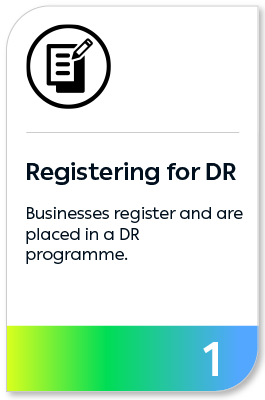
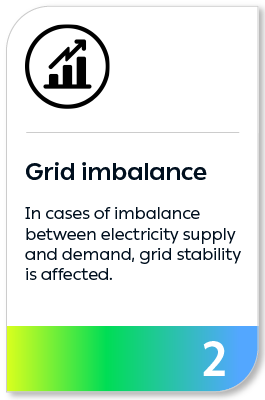
Demand Response programmes reward businesses for temporarily reducing or increasing their energy consumption in a targeted manner, and help balance the electricity grid.
This way, demand response offers:
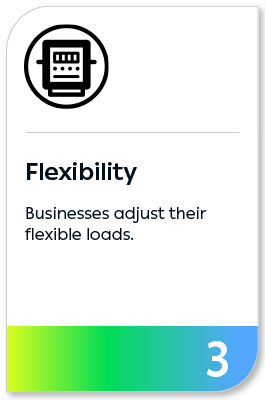
- Flexibility in consumption - Businesses adapt flexible loads as needed, without interrupting their critical processes.
- Benefits for businesses - They receive rebates and document added ESG value.
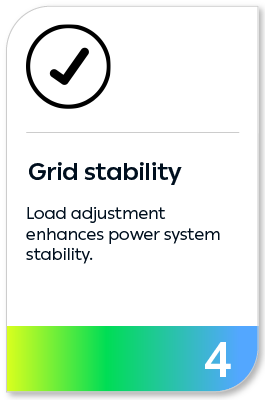
- Grid stability - System reliability and performance are enhanced.
How it works
How your business benefits
Secure major advantages by registering for a Demand Response portfolio:
- Create a new revenue stream – With cash rebates linked to the level of participation and the amount of flexible load.
- Lower your energy cost – With electricity bill savings.
- Reduce your environmental footprint – With lower consumption and by supporting the integration of renewable energy sources in your organisation.
What businesses can participate
Demand Response programmes are addressed to high- and medium-voltage businesses, with significant energy demands and load flexibility.
Examples of such businesses:
- Industrial facilities – Chemicals, plastics, steel, pharmaceuticals, paper, packaging
- Refrigeration and food facilities – Cold rooms, food storage facilities, food production
- Commercial and public buildings – Offices, malls, public buildings, hospitals, hotels
- Water and utility infrastructure – Pumping stations, water supply and filtration systems
- IT centres and high-consumption infrastructure – Data centres, ports and shipyards
- Supply chains and retail – Logistics centres, storage facilities, stores
Why choose us
Systematic process
We invite you to contact us so that we can assess whether your business has flexible loads that allow you to register for a demand response programme. Together, we design a technical solution tailored to your needs to ensure the uninterrupted operation of your business, and we supply the necessary equipment.
After a trial period, we place your business in the appropriate IPTO Demand Response portfolio. This way, you can participate in the Greek balancing market.
Integrated approach
Our solution includes:
- Digital DR platform – You monitor your load curve in real time and track your revenues and the reduction in the carbon footprint of your business
- System analysis – We carry out a flexibility study of your infrastructure to identify flexible loads and adapt the solution to your technical capabilities.
- Energy optimisation and submission of offers – We manage energy in a strategic way and participate in the energy markets to achieve maximum performance and profitability.
FAQs
What equipment will I get if I register for a Demand Response programme?
- Gateway | Our Gateway acts as the main hub for collecting data and checking loads. You install it in your building and it is responsible for collecting consumption data and transmitting activation signals to the management system.
- 4G router | You use a 4G router for connecting the Gateway to the internet, so that it communicates with our platform.
- Power meters | If needed, you use power meters to collect data about local loads, which are then sent to Gateway.
I have another energy provider. Can I register for a PPC Demand Response programme?
Yes. We can place your business in a Demand Response programme no matter who your energy provider is.
Which product does PPC use in the Demand Response programmes?
We use IPTO’s manual Frequency Restoration Reserve (mFRR). This product ensures immediate frequency restoration when unforeseen supply and demand imbalances occur.